 Joha
Seven O'Clock at the Window
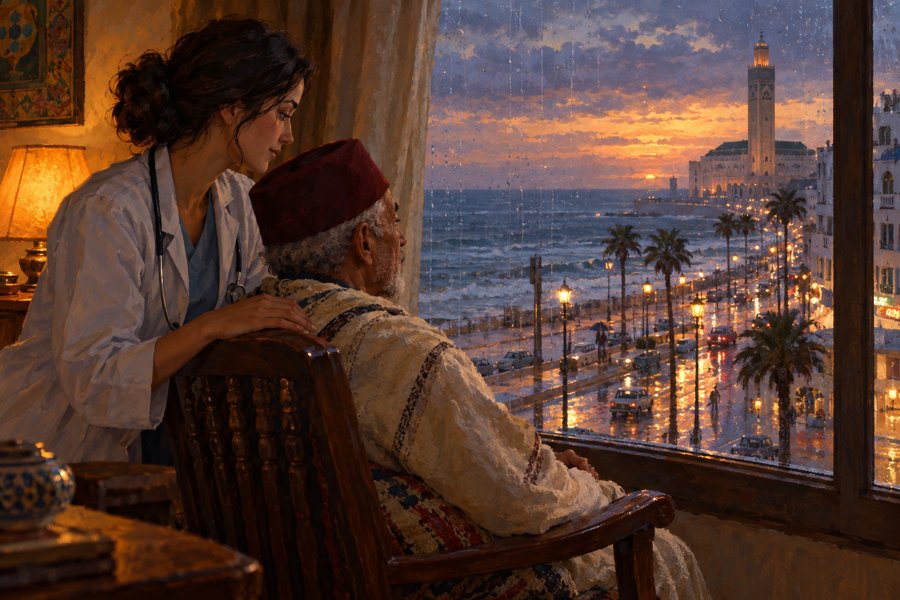
Layla worked as a nurse in a small care home on the Casablanca seafront, and every evening at exactly seven she saw the same scene. Hajj Driss, an eighty-three-year-old man, rose slowly from his bed, took his cane and walked to the window that overlooked the street. He sat on the wooden chair, put his hands on his knees, and waited.
In her first week she asked him: "Who are you waiting for, Hajj?" He looked at her with clear eyes and said: "Samira. She will come at seven, as always." Then he went back to his silence. The disease had taken the names of his children and the years of his life, but it had left him one thing that would not move: seven o'clock, the window, and a woman named Samira.
The director told her sadly: "Samira was his wife. She died eight years ago. Do not try to tell him the truth. The first time we did, he cried as if he were hearing it for the first time, and he did not eat for three days. We let him wait. There is no harm in it."
But Layla could not bear to see the man wait every evening for a woman who would never come. Sometimes she sat beside him and talked about the weather and the sea. He would smile and say: "You are kind, my daughter. You look like Samira when she was young." And Layla felt her heart tighten.
One winter night the wind rattled the windows and the power went out for half an hour. Layla took a lamp and went into Hajj Driss's room to check on him. She found him sitting at the window in the dark, the faint light of the street on his face. "Do not worry," he said. "Samira will not be late because of the rain. She promised me."
"What did she promise?" Layla asked. In a trembling voice he said: "Before she left she told me: Driss, I will come back to you at seven every evening, so wait for me at the window. And do not worry, I will not forget you."
Layla sat on the edge of the bed, her eyes filling with tears. She did not know whether Samira had really said it, or whether the mind of a man who was fading had turned grief into a promise to hold onto. But she knew the promise was keeping him alive.
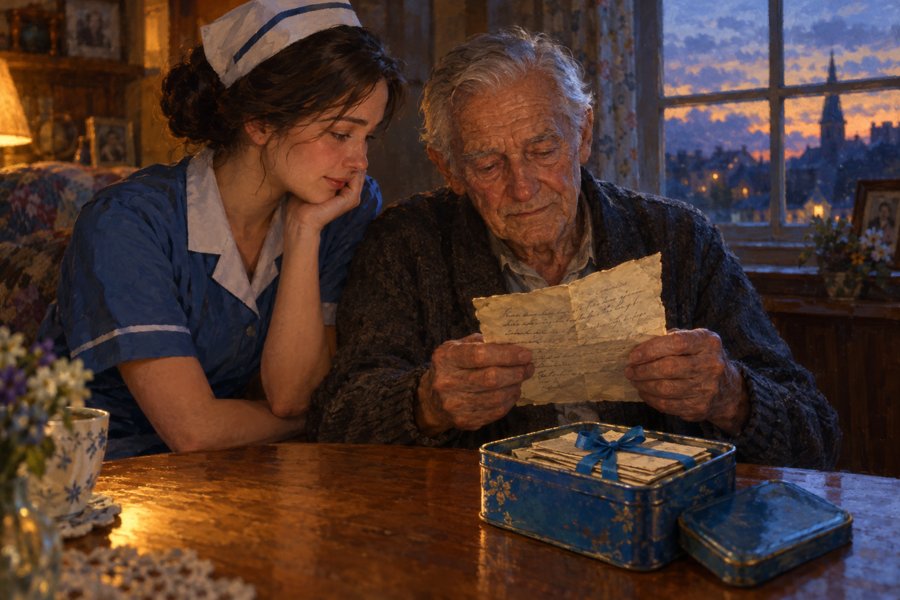
Two days later, while tidying Hajj Driss's wardrobe, she found a small tin box in an old wooden drawer. She opened it and found many letters tied with a blue ribbon, and on the first envelope, in a woman's beautiful handwriting: "To Driss, to be read when you remember nothing."
Layla's hands shook. She had no right to open the letters. But she remembered what was written on them: to be read when you remember nothing. She went to the director and told her. The director was quiet for a long time, then said: "His only son lives in Canada, and we have told him about his father's condition. If this is a letter from his wife, it belongs to him before anyone. Read it to him, but carefully."
That evening at six-thirty, Layla sat beside Hajj Driss at the window. "Hajj," she said, "a letter has come for you from Samira." He looked at her with a child's eagerness. "A letter? Where is it?" She gave him the envelope, but he could not read it himself, so she took it back, opened it with trembling hands, and read in a low voice:
"Driss, love of my life. If you are reading this, then your memory has begun to betray you, and I am no longer beside you to remind you. Do not be sad. I wrote it in the days when I learned that I would not stay long. I want you to know three things. First, I loved you every day for fifty years, even on the days I was angry with you. Second, the window where we sat every evening at seven was the most beautiful place in the world, because you were beside me. And third, when I am gone, if you begin to wait for me, do not wait too long. Sit a little, then rest, and I will be waiting on the other side of the window."
Layla stopped because her voice failed her. Hajj Driss was still, and a large tear ran down his white cheek. "She wrote to me," he said in a voice that could barely be heard. Then he closed his eyes as if listening to something far away. "Do you hear? She is laughing. That is her laugh when I am late."
Layla read letter after letter through the following weeks, one each evening before seven. Driss listened each time as if for the first time, and smiled, and Layla waited with him at the window. For the first time in years, when the clock struck seven he no longer looked anxious. He seemed like someone who knew that the one who was coming was no stranger.
On an evening in late winter, when seven o'clock struck, Driss sat at the window as usual. Layla beside him held the last letter in the box. On the envelope was one line: "Open it when the time comes." Layla opened it. Inside was a single sheet with a single word: "Come."
She read it to him in a breaking voice. She turned and saw him smiling, his eyes on the street as if he saw something she could not. "Here she is," he said quietly. Then he rested his head against the window glass and closed his eyes.
When Layla looked at the clock it showed five past seven. She stayed beside him for a long time, holding his hand, which no longer held a cane, while the rain tapped gently on the glass.
The next morning his son arrived from Canada. Layla stood at the door and handed him the blue tin box. "This is your mother," she said. "Your father waited for her until she came." And after that the window at seven no longer made her sad, because she knew that some waiting ends with the one who deserved to arrive.

Enjoyed the story? Share it:
WhatsAppFacebook