 Joha
‹ All parts: The Lighthouse That Never Goes Out
The Lighthouse That Never Goes Out - Part 2: The Notebook Without End
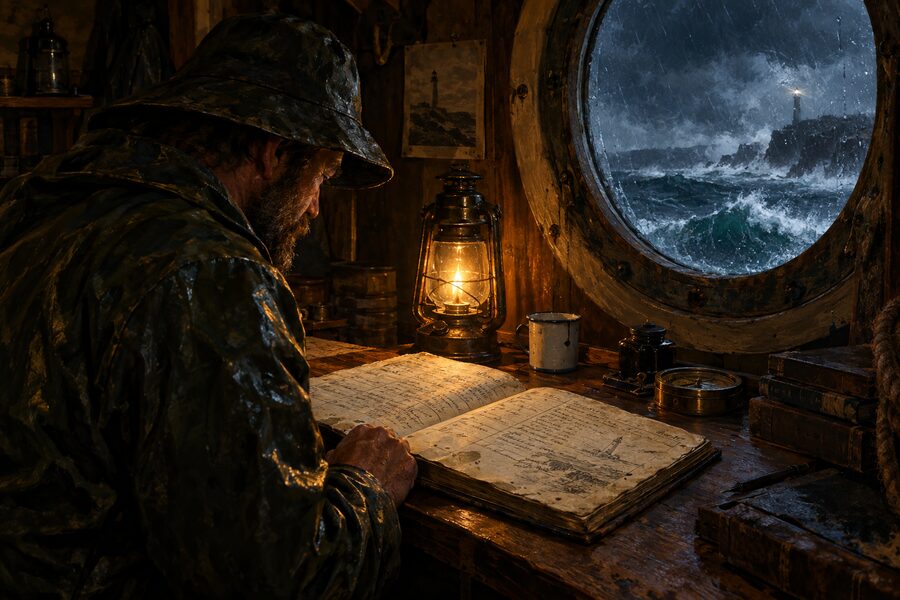
Karim did not breathe. The knocking came again, three slow blows, the way his father used to knock on the door of their house when he came back from the sea at night. "Karim, my son," the voice said. "Open the door. It is cold, and the sea is angry."
Karim leaned over the iron rail. Far below, the doorstep was empty in the lantern's beam. Nobody stood there. Yet the knocking went on, and the voice went on, patient, tender, exactly as he remembered it. His father had drowned ten years ago, when his boat never returned from the winter fishing. Karim had searched the coast for forty days and found only a single oar.
He understood the trick. Whatever stood at the door wanted him to leave the lamp and come down, and he thought of the page: "Do not put out the light before dawn." He turned his back on the voice, went into the lamp room, and looked at the great lens. The flame was small and trembling, and the oil in the reservoir was nearly dry.
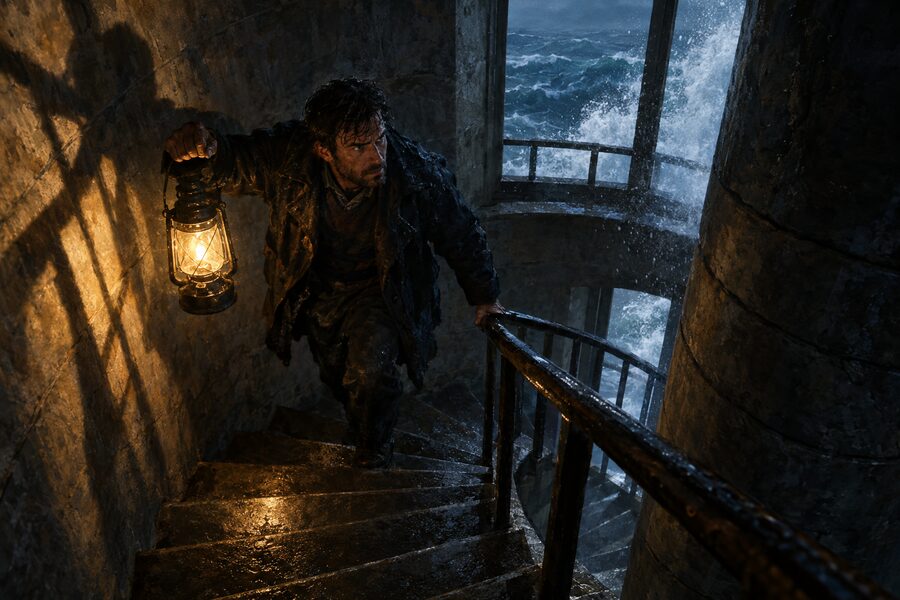
"The oil," he muttered. "A whole night, and there is no oil."
The voice below grew softer. "Come down, my son. There is oil in the cellar. I will show you."
Karim hesitated. He had not seen the cellar. Maybe the voice, whatever it was, spoke the truth about that. He took the notebook from the desk, because he could not bear to leave it, and opened it to the last page. The fresh handwriting had changed again. It now said: "The cellar holds the oil. Do not bring the voice inside. Do not answer it by name."
His throat tightened. The notebook was warning him, and the notebook seemed to know the voice was there. He took the lantern, found an iron hatch behind the desk, and pulled it open. Stone steps went down into the heart of the tower, and cold air rose from below, smelling of tar and old wood.
The cellar was a round room lined with barrels. Karim tapped them one by one. Most were empty, their sound hollow. The last one rang full. He rolled it to the steps and, with a sailor's strength, hauled it up, step after step, his shoulders burning.
As he reached the top, the knocking stopped. The silence was worse. Then, behind the door, came the voice again, but now sad: "You do not love me, Karim? You have not opened the door for ten years."
Karim closed his eyes. His heart said, open. His mind said, no. He whispered, without answering the name: "Whoever you are, the light matters more than my grief tonight."
He poured oil into the reservoir with shaking hands, and the flame rose. A great white beam swept out over the sea, and from the dark came a faint distant sound, like a horn, answering it. Hope warmed him. Perhaps some of the boats had seen the light.
He ran to the balcony. The scattered lights at sea had moved: some were turning toward the beam, but others still drifted toward the rocks. And among them, far out, was a larger light, steady and pale green, that did not sway with the waves. It moved against the wind, straight toward the lighthouse.
Karim leaned on the rail and strained his eyes. In the green light, a ship slowly took shape out of the fog, a tall old ship with torn sails, a ship that should have been broken on the reef long ago. On its deck, rows of figures stood motionless, all looking up at the tower.
Behind him, in the lamp room, the notebook turned its pages by itself. Karim came back inside and saw what it had written in fresh ink: "The ship that does not anchor is coming. Do not let it see the keeper's face. Do not let it read your name. Keep the light, and keep your silence."
His mouth was dry. He looked at the lens. The flame, so strong a moment ago, was shivering. The oil was fine, but something else was drawing the fire down, as if the ship breathed it in.
Down below, the knocking started again, but this time it was not at the door. It came from the staircase inside the tower, slow steps rising, one by one. The door, he realized, had never needed to be opened.
Karim grabbed the iron poker from the stove and stood in front of the lens, shielding it with his body. The steps climbed higher. He counted them aloud, to keep his courage: forty, forty-one, forty-two. The handle of the lamp-room door began to turn.
In the gap that opened, there was no face. Only a hand, a man's hand, rough and scarred, with a missing finger. Karim knew it. His father had lost that finger to a fishhook when Karim was a boy.
"Karim," said the voice, very close now, very gentle. "I only came to tell you one thing before the ship arrives. The keeper's name written in this notebook is not what you think. Look at the last signature."
Karim could not stop himself. He glanced at the page. The incomplete signature, "The keeper...", was no longer incomplete. Someone had finished it, in ink still wet. It read: "The keeper Karim."

Enjoyed the story? Share it:
WhatsAppFacebook